.jpg?width=1200&height=630&name=Untitled%20design%20(3).jpg)

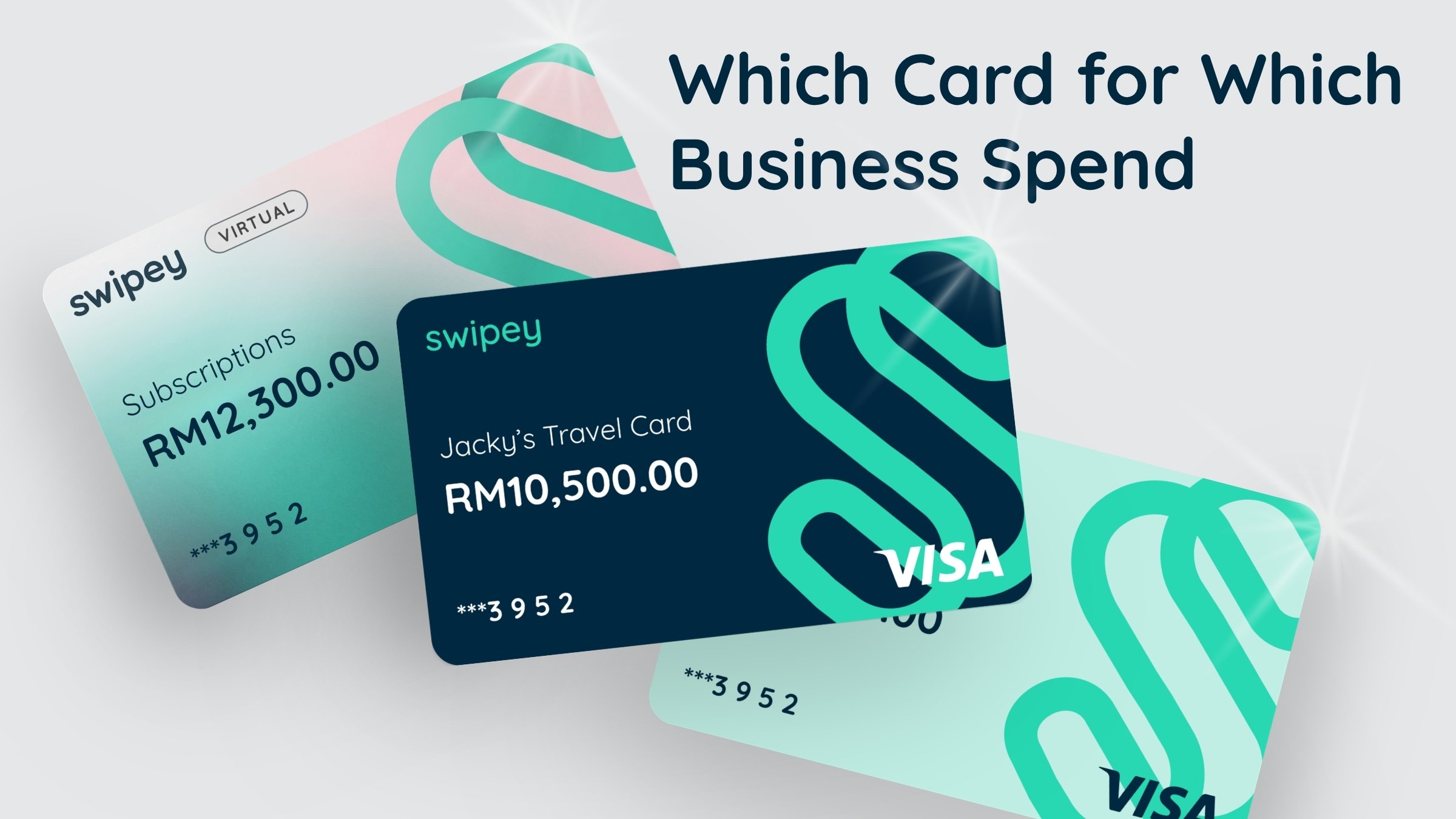
Prepaid, virtual, corporate. If you run a business in Malaysia, you have probably been told to pick one card and stick with it. That advice quietly costs you money. These are not three versions of the same thing competing for your wallet. They do different jobs, and the businesses that spend well use all three, each for the spend it handles best.
The confusion is fair, because the words get used as if they sit on the same shelf. They do not. Two different questions are hiding inside them, and once you separate the two, the right card for any given payment becomes obvious.
The short version
✓ Prepaid is for capped, controlled spend. Load it, hand it over, and it stops at the limit. Think travel and one-off campaigns.
✓ Virtual is for online subscriptions. One card per tool, so nothing lapses and a leak stays contained.
✓ Corporate is for the spend that has to clear every time, and it reconciles straight into your books.
Two questions people mix up
The first question is how a card is funded and where it gets accepted. That is the difference between prepaid and corporate. A prepaid card spends money you have already loaded onto it. A corporate card draws on your business account and is accepted in far more places, including the platforms that routinely turn prepaid cards away.
The second question is what form the card takes. That is the difference between virtual and physical, and it has nothing to do with how the card is funded. A virtual card is simply a card number with no plastic. It can sit on top of a corporate account or a prepaid one.
So “prepaid vs virtual vs corporate” is really two decisions, not one. First, how should this spend be funded and where does it need to work. Second, does it need a physical card or a virtual one. Answer both and you land on the right card every time.
What each card is for
Prepaid card
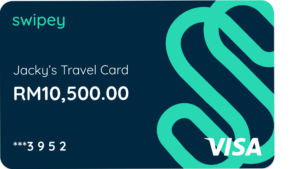
You load funds first, then spend what is on it. When the balance runs out, it stops. That is the whole point. A prepaid card is the right tool when you want a hard ceiling:
- a marketing campaign with a fixed budget
- per-diems for a team trip
- a card you hand to a staff member without opening up the main account
Swipey’s own Travel card is prepaid for exactly this reason. The trade-off is acceptance. Some platforms decline prepaid cards, so it is not the card for spend that simply has to go through.
Virtual card
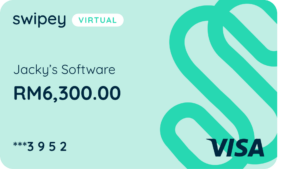
A virtual card is a card number generated digitally, with no plastic. You can create one in seconds, use it online straight away, and freeze or delete it just as fast. Its strongest use is recurring online spend. Give each subscription or vendor its own virtual card and a single service can never take down all your payments at once. If a number leaks, you kill that one card and the rest keep working. Because virtual is a form factor rather than a funding type, a virtual card can run on top of your corporate account and inherit all of its acceptance.
Corporate card
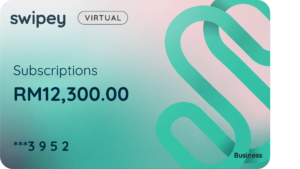
A corporate card is the main operating card for the business, built for the spend that cannot fail: the tools, platforms and suppliers you pay every month. It clears where prepaid often gets declined, including Google, OpenAI, Microsoft and Azure. You can set spend limits per person, issue cards across the team without handing over the bank login, and see everything in one dashboard. With Swipey, that spend feeds straight into Bukku, so what you buy on Monday is categorised in your books by Tuesday. And for a limited time, you earn 1% cashback on it. Learn more about what a Corporate Card can do
Learn more about the differences between Swipey’s cards and how they work for your business
Which card for which spend
Match the spend to the job, not to a category. For a typical Malaysian business, it usually shakes out like this.
| Spend type | Best fit | Why |
|---|---|---|
| Google Ads, OpenAI, Microsoft, Azure | Corporate | These platforms often decline prepaid cards. A corporate card clears, so campaigns and cloud bills never stall. |
| Online subscriptions and SaaS tools | Corporate / Virtual | One virtual card per tool. Nothing lapses, and a leak or a surprise price rise is contained to a single card. |
| Team travel and per-diems | Prepaid | Load a fixed amount, hand it over, and spending stops at the limit. Clean and capped. |
| One-off campaign or project budget | Prepaid or virtual | Set the ceiling up front so the budget cannot be overshot. |
| Recurring supplier payments | Corporate | Pay suppliers by DuitNow QR from the same card, then let it reconcile into your books. |
| Everyday operating spend across the team | Corporate | Per-person limits, one dashboard, and every ringgit landing categorised in Bukku. |
The mistake that costs you
None of these is the “bad” card. A prepaid card is not a weaker corporate card, and a corporate card is not a fancier prepaid one. The expensive mistake is putting the wrong spend on the wrong card. A critical ad account on a prepaid card that gets declined mid-campaign stops your leads overnight. A large travel budget on an open operating card with no ceiling invites overspend. Get the match right and each card quietly does the thing it is good at, which is the whole goal.
Where Swipey fits
Most business finance tools are built for one slice of this, usually moving money across borders. Swipey is built for the other 90% of your week: paying suppliers by DuitNow QR, keeping your ad platforms and cloud bills from declining, and closing the books without the month-end scramble.
It is one loop. You pay the way Malaysia actually pays, you spend where prepaid gets declined, and it all reconciles into Bukku, in ringgit, already on your books.
Want the full picture? Download the Swipey overview deck to see how the whole pay, track and close workflow fits together.
Put the right spend on the right card
The Swipey Corporate Card clears where prepaid gets declined and reconciles straight into Bukku, built for how Malaysian businesses actually run.
Digital spend earns 1% cashback for a limited time. See full terms.