Quick answer
Overseas card spend usually costs Malaysian businesses two things on top of the price: a card fee of around 1% to 1.25% on foreign transactions, and 8% service tax on digital services from foreign providers such as ads and software. Always pay in the merchant's currency when asked, set card limits on the total including tax, and check how each card's cashback offsets its fees.
The price on a software plan or ad invoice is rarely what leaves your account. This guide breaks down every layer of cost on overseas card spend, with a worked example, so you can budget for the real number.
What is a foreign transaction fee?
It's the extra your card issuer charges when you pay a foreign merchant or in a foreign currency. It usually appears as a percentage added to the card network's exchange rate, so you rarely see it as its own line. It just makes the ringgit amount on your statement a little higher than you expected.
Some cards also charge a fee based on where the merchant is, not the currency. So a foreign platform billing you in ringgit can still carry a fee.
What business cards charge on overseas spend
| Card |
Fee on overseas spend |
Notes |
| CIMB SME BusinessCard |
Mastercard rate + 1%[1] |
Also pays 1.25% cash rebate on overseas spend |
| Public Bank business cards |
Visa or Mastercard rate + 1.25% FX spread[2] |
Applied to the converted ringgit amount |
| Airwallex |
0.40% FX mark-up on major currencies, 0.60% on others[3] |
Per its fee schedule; Visa may apply its own rate and fees |
| Swipey (all cards) |
1% International Service Assessment on merchants outside Malaysia[4] |
A card-network fee; Corporate Card earns 1.1% cashback on eligible software spend |
From each provider's own fee page, read 3–4 November 2026. Fees change, so check before you choose.
Dynamic currency conversion: always pay in the local currency
Abroad, a terminal or checkout page may offer to charge you in ringgit instead of the local currency. That's dynamic currency conversion, and the merchant's exchange rate is usually worse than your card network's.
Choose the local currency every time. Your card then converts at the network rate, and you only pay your card's published fee instead of an extra, hidden one.
8% service tax on foreign digital services
Foreign providers of digital services that are registered with Malaysian Customs add service tax to what they bill Malaysian customers. The rate rose from 6% to 8% from 1 March 2024.[5] That covers much of a modern business's overseas spend: ads, software, cloud and AI tools.
Where a foreign provider doesn't charge it, your business may need to account for service tax on imported services itself. The rules depend on what you buy and how your business is registered, so check your position with your tax adviser.
Not tax advice. Check your invoices and your obligations with your accountant.
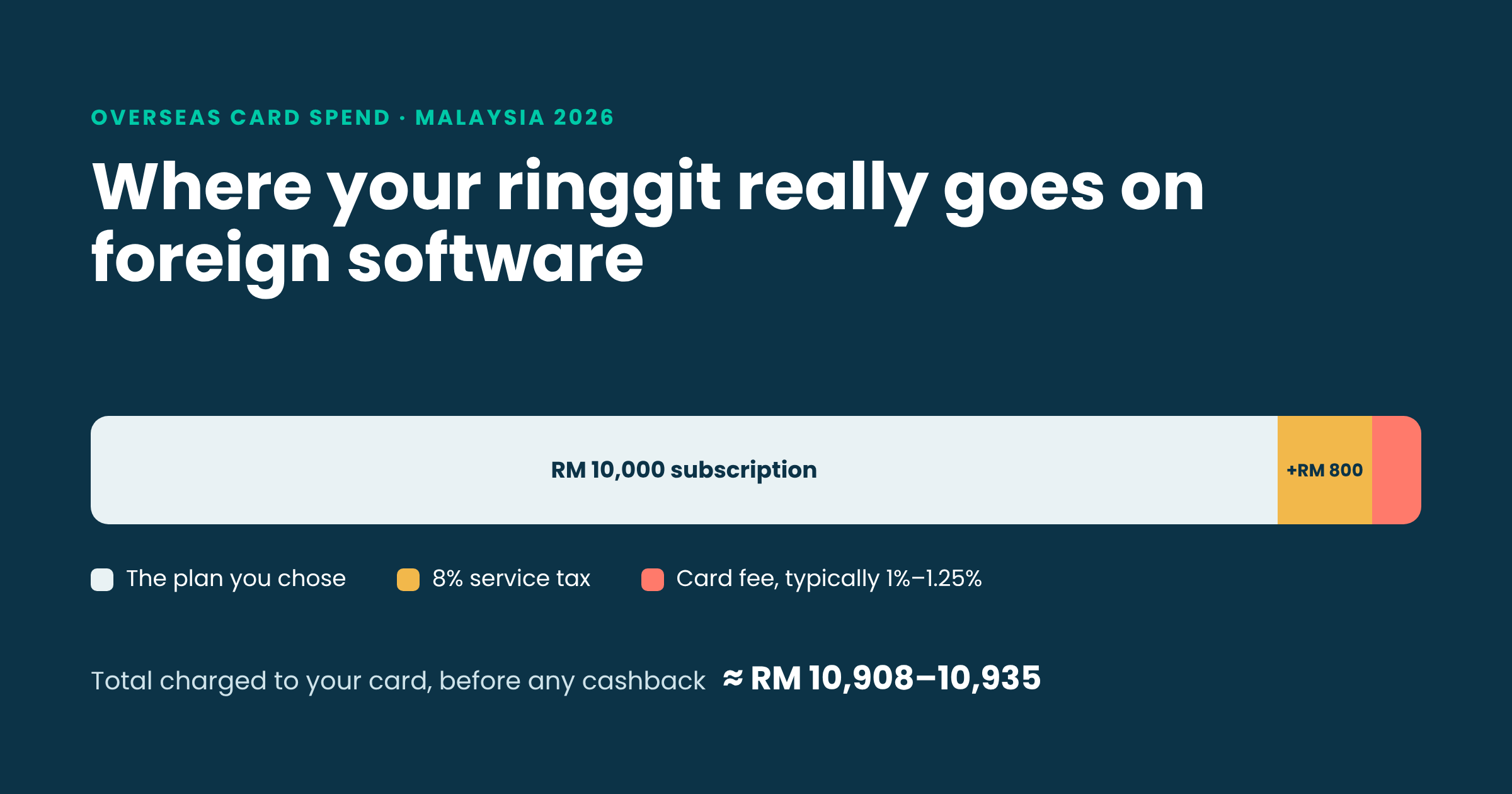
Worked example: RM10,000 a month of foreign software
SubscriptionsRM10,000
8% service tax, charged by the providerRM800
Card fee at 1%–1.25% of RM10,800RM108–135
Charged to your cardRM10,908–10,935
Cashback or rebates can offset the card fee, so compare the net cost, not just the fee. On the Swipey Corporate Card, eligible software spend earns 1.1% cashback, with no monthly cap per company (terms apply).
How to keep overseas costs down
1. Bill in ringgit where you can. Many platforms, including Meta ads, let you set the account currency to MYR, which removes conversion. A merchant-location fee may still apply.
2. Refuse dynamic currency conversion. Always pick the local currency at checkout.
3. Compare net cost, not headline fees. A card with a fee and strong cashback can cost less than one with a lower fee and none.
4. Set limits on the total. Budget for tax and fees, or they're what tips a renewal into a decline.
5. Keep the invoices. Service tax lines need to be on record for your accountant and your audit.
Going deeper on a platform? See how to pay for Meta ads from Malaysia, how to pay for SaaS and AI tools, or the best business cards in Malaysia.
FAQ
How much is the foreign transaction fee in Malaysia?
It depends on the card. Business cards we checked add around 1% to 1.25% on top of the card network's exchange rate. Check your issuer's fee schedule for the exact figure.
Do I pay SST on Google or Facebook ads?
Usually, yes. Foreign digital service providers registered in Malaysia add service tax to Malaysian invoices, and the rate has been 8% since 1 March 2024. Check your invoices and ask your accountant how to treat it.
What is dynamic currency conversion?
It's when a foreign merchant offers to charge you in ringgit instead of its local currency, usually at a worse rate than your card network's. Choose the local currency to avoid it.
Do I need to self-account service tax on imported services?
Possibly, where a foreign provider doesn't charge Malaysian service tax itself. The rules depend on what you buy and how your business is registered, so confirm with your tax adviser.
See exactly what you pay on overseas spend
A Corporate Card per tool, every charge and tax line in one dashboard, and spend synced to your books. Trusted by 4,000+ Malaysian businesses.