In short
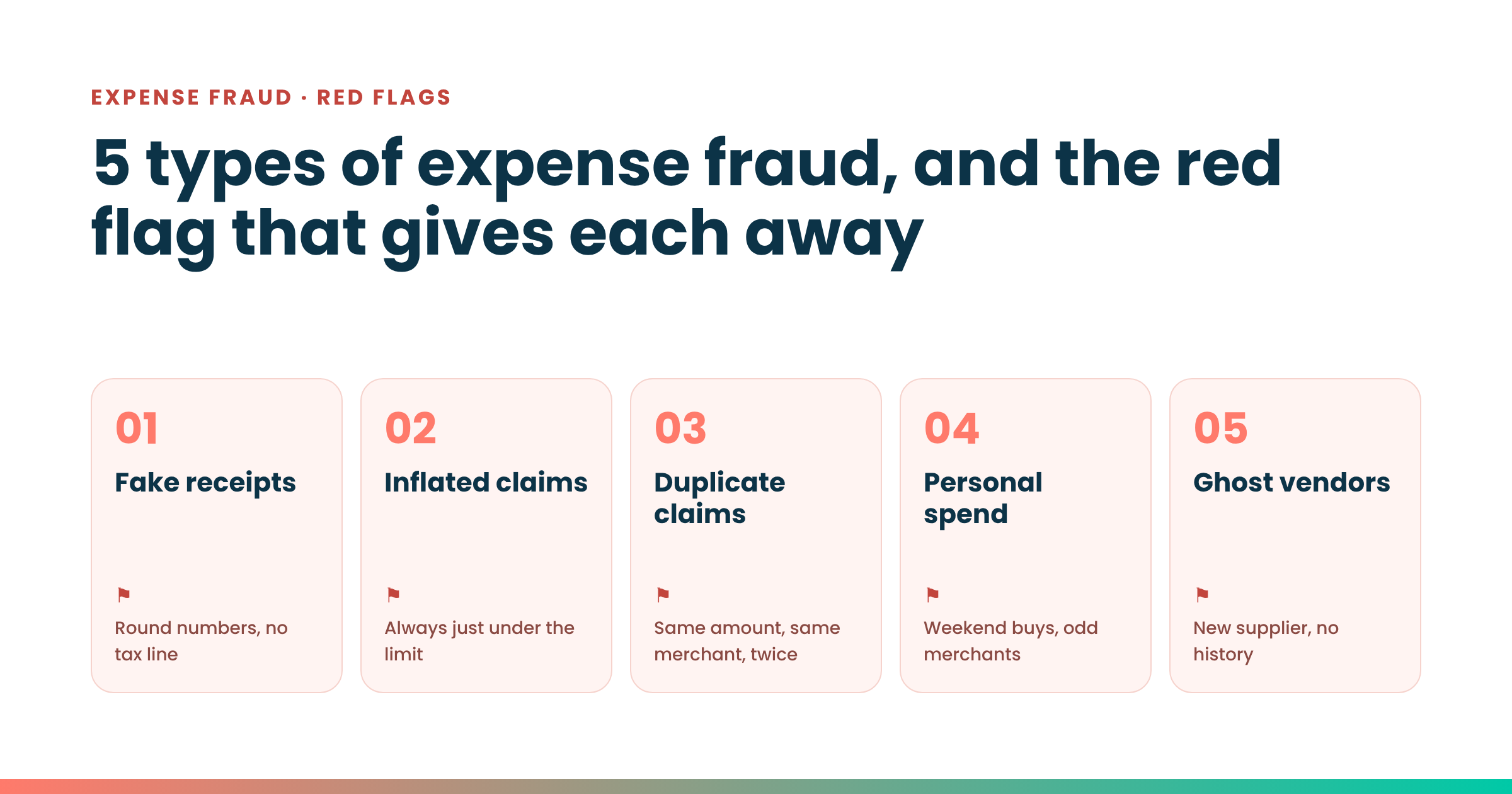
The five most common types of business expense fraud are fake or altered receipts, inflated claims, duplicate claims, personal spending on company money, and ghost vendors. Most are prevented the same way: give staff individual cards with limits, capture receipts when money is spent, and approve spend and supplier bills before they're paid.
Expense fraud is common and costly. In the ACFE's 2024 global study of occupational fraud, expense reimbursement schemes appeared in 13% of cases, and organisations with fewer than 100 employees had a median loss of US$141,000 per case.[1]
Not every bad claim is deliberate. A receipt submitted twice by mistake costs the same as one submitted twice on purpose, so the goal is a process where neither can happen easily.
What is expense fraud?
Expense fraud is when someone gets the business to pay for expenses that are fake, inflated or personal. It usually happens through reimbursement claims or misuse of a company card, and it's hardest to spot when receipts are on paper and spend is reviewed weeks after the fact.
The 5 types at a glance
| Type |
Example |
Red flag |
Control |
| Fake receipts |
A "client lunch" receipt made online |
Round numbers, no tax line, no merchant details |
Pay by company card so every expense starts as a real transaction |
| Inflated claims |
Mileage or Grab fares rounded up every month |
Claims always just under the approval limit |
Card amounts come from the merchant, not the claimant |
| Duplicate claims |
The same hotel bill claimed by two colleagues |
Same amount and merchant on two claims |
One transaction, one receipt, no separate claim |
| Personal spend |
Family dinner on the shared company card |
Weekend or holiday spend, unusual merchants |
A named card per person with a limit, frozen if misused |
| Ghost vendors |
Invoices from a "supplier" an employee controls |
New supplier, personal bank account, no delivery records |
Every bill approved by someone else before it's paid |
1. Fake or altered receipts
What it looks like: a receipt for a meal or purchase that never happened, made with an online generator or edited from a real one. It's most common where small claims don't need a receipt at all.
Red flags: round amounts, missing SST or merchant registration details, receipts that all look alike.
How to prevent it: move spend onto company cards. When every expense begins as a card transaction with a real merchant, there's no claim to invent. The receipt only has to match a payment that already exists.
2. Inflated claims
What it looks like: a real expense claimed for more than it cost, like rounded-up mileage, a hotel upgrade claimed at the standard rate plus extra, or a tip that wasn't paid.
Red flags: claims that always sit just under the approval limit, or one person's costs running well above their teammates' for the same trips.
How to prevent it: set clear per-diem and travel limits, and let the card enforce them. With a company card, the amount comes from the merchant, so there's nothing to round up.
3. Duplicate claims
What it looks like: the same expense paid back twice, either by one person submitting it in two months or by two colleagues who shared a bill each claiming it. It's often accidental.
Red flags: matching amounts, dates and merchants across claims, or a receipt photo and a paper copy of the same purchase.
How to prevent it: replace reimbursement with card spend. Each purchase is one transaction, and the receipt is attached to it when it's made. In the Swipey app, staff snap the receipt and Alfie matches it to the right transaction.
4. Personal spending on company money
What it looks like: personal shopping, meals or trips paid with a company card or petty cash, then labelled as a business expense, or not labelled at all.
Red flags: weekend and public holiday spend, merchants that don't fit the role, and shared cards where no one can say who made a purchase.
How to prevent it: end shared cards. Give each person their own card with a limit that matches their role, so every transaction has a name on it. If something looks wrong, freeze the card instantly and claw back the balance. Here's how in our guide to corporate card controls.
5. Ghost vendors
What it looks like: invoices from a supplier that doesn't exist, or that an employee secretly controls, paid into a bank account they own.
Red flags: a new supplier with no history, a personal bank account in the supplier's name, round invoice amounts, and no delivery or work records.
How to prevent it: separate who adds a supplier from who approves payment. With Swipey's bill payments, every bill is reviewed by authorised people before it's paid, and each payment stays linked to its invoice.
Expense fraud prevention checklist
✓ A written expense policy staff have actually read
✓ Individual company cards instead of shared cards or petty cash
✓ A limit on every card that matches the policy
✓ Receipts captured at purchase, not at month-end
✓ Supplier bills approved by someone other than whoever added the supplier
✓ A monthly look at spend by person, merchant and day of week
These same controls make audits faster too. See the 6 challenges auditors face, or compare tools in the best expense management software in Malaysia.
FAQ
What is expense fraud?
It's when someone gets a business to pay for expenses that are fake, inflated or personal, usually through reimbursement claims or misuse of a company card.
How do companies detect expense fraud?
By looking for patterns: claims just under approval limits, matching amounts across claims, weekend or unusual merchants, and new suppliers with no history. It's far easier when every transaction is tied to a named card and a receipt.
What should an expense policy include?
What counts as a business expense, spending limits by role and category, when receipts are needed, who approves what, and what happens when the policy is broken.
Stop expense fraud before it happens
A named card per person, a limit on each, receipts matched as staff spend, and bills approved before they're paid. Trusted by 4,000+ Malaysian businesses.